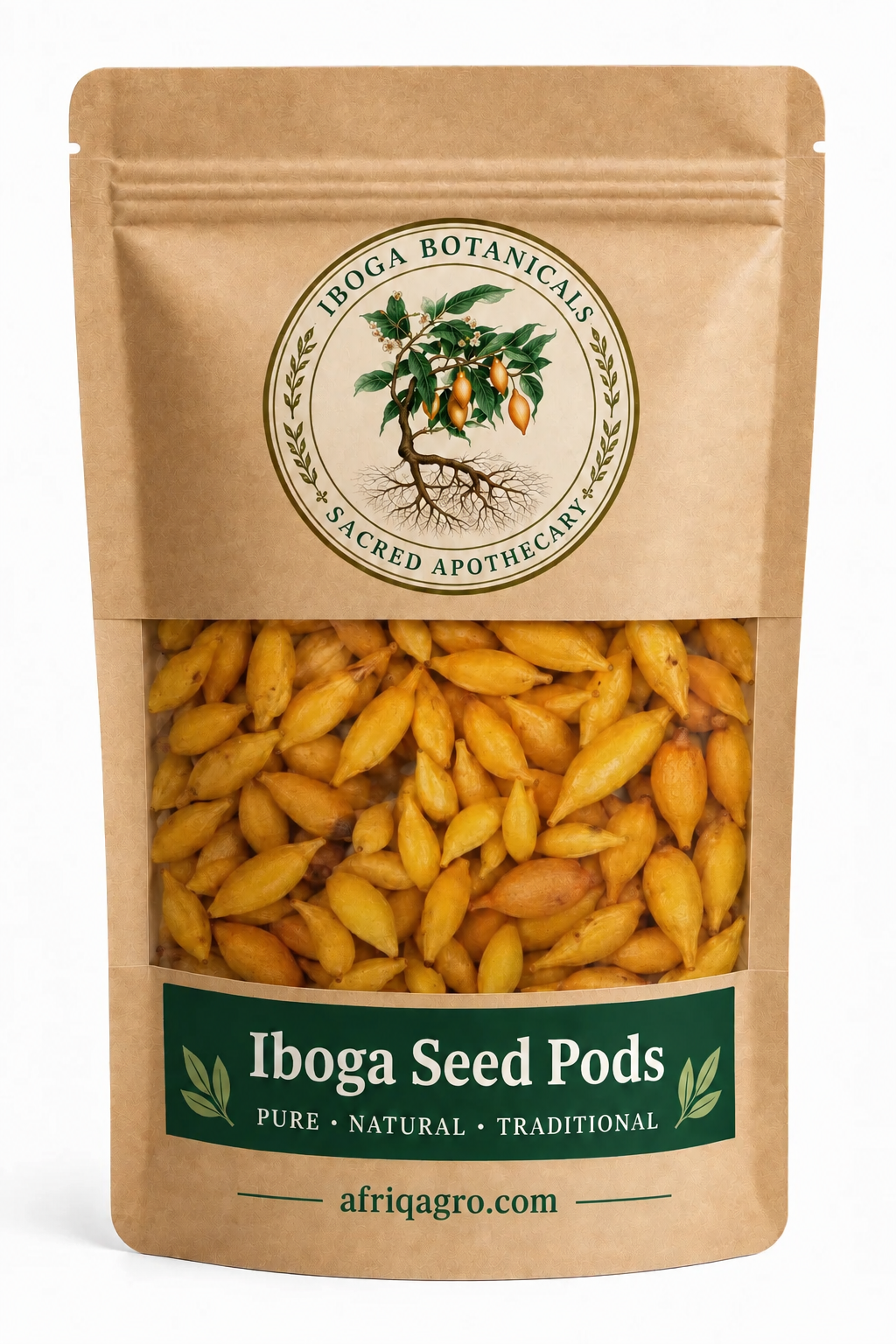
Iboga seed pods
Technical Specifications
-
Botanical Name: Tabernanthe iboga
-
Family: Apocynaceae
-
Specimen Format: Whole, intact ripe seed pod
-
Average Content: Variable seed count per pod (embedded in natural pulp)
-
Purity: 100% natural, untreated botanical specimen; zero chemical preservatives or pesticides
-
Origin: Ethically harvested in Central Africa (Gabon/Cameroon region)
All deliveries are 100% guaranteed and shipped in discreet, secure packaging to protect your privacy.
Iboga Seed Pods – Tabernanthe Iboga Botanical Specimen
Iboga seed pods are botanical fruit and seed specimens produced by Tabernanthe iboga Baill., an African shrub or tree belonging to the Apocynaceae family.
Kew’s Plants of the World Online recognizes Tabernanthe iboga as an accepted species native from West-Central Tropical Africa into Angola. Its documented native distribution includes Cameroon, Central African Republic, Gabon, Congo, Democratic Republic of the Congo, Cabinda and Angola. Plants of the World Online
Additionally, intact fruit and seed material can provide useful reference characteristics for botanical identification, collection records and comparative study.
Iboga Seed Pods Overview
The Iboga seed pods listed by AfriqAgro are presented as botanical specimens from Tabernanthe iboga.
Rather than treating all pods as identical, the listing should document the characteristics of the actual batch. Natural fruit and seed specimens can vary in size, color, maturity and external appearance.
Therefore, useful product information should include:
- Botanical species
- Plant family
- Plant part
- Fruit or pod condition
- Seed condition
- Geographic origin
- Harvest date when available
- Batch or lot number
- Net quantity
- Packaging information
- Storage recommendations
Moreover, accurate documentation helps distinguish the specimen from other Tabernanthe species and unrelated African botanicals.
For related botanical products and reference specimens, browse the AfriqAgro marketplace.
Botanical Identity of Tabernanthe Iboga
The accepted scientific name is Tabernanthe iboga Baill.
Its botanical classification includes:
- Kingdom: Plantae
- Order: Gentianales
- Family: Apocynaceae
- Genus: Tabernanthe
- Species: Tabernanthe iboga
Kew currently recognizes Tabernanthe iboga as an accepted species. Therefore, this scientific name should be used consistently across the title, product description, image ALT text and batch documentation. Plants of the World Online
The genus Tabernanthe currently contains two accepted species in Kew’s taxonomy: Tabernanthe iboga and Tabernanthe elliptica. Plants of the World Online
For authoritative botanical taxonomy, use:
Kew – Plants of the World Online: Tabernanthe iboga
Geographic Origin
Tabernanthe iboga is native to West-Central Tropical Africa through Angola.
Kew documents native occurrence in:
- Angola
- Cabinda
- Cameroon
- Central African Republic
- Republic of the Congo
- Democratic Republic of the Congo
- Gabon
The species is described as a shrub or tree associated primarily with the wet tropical biome. Plants of the World Online
However, the species’ natural range should not automatically be presented as the origin of every commercial batch.
Therefore, if your actual AfriqAgro seed pods come from Cameroon, Gabon, or another documented source country, list only the country supported by your supplier or harvest records.
Iboga Fruit and Seed Characteristics
Botanical references describe the fruit of Tabernanthe iboga as a many-seeded berry rather than a dry seed pod in the strict botanical sense.
PROTA describes the fruit as globose, ellipsoid or ovoid, approximately 3–6.5 cm long, with yellow-to-red coloration and numerous seeds surrounded by pale pulp. It describes the seeds as ellipsoid, around 7–10 mm long, with a deeply indented surface. Prota
Consequently, “Iboga seed pods” can remain your customer-facing search phrase because that is how people may search for the product, while the product description can use more precise terms such as:
fruit and seed specimen
or
whole iboga fruit containing seeds
when that accurately describes the batch.
Seed Pod Botanical Format
The product may be presented as a whole fruit specimen, fruit containing seeds, or separated seed material depending on the actual stock.
For accurate documentation, specify whether the product consists of:
- Whole fruit
- Dried whole fruit
- Fruit containing seeds
- Individual seeds
- Mixed fruit-and-seed specimen
Furthermore, do not describe a batch as fresh, mature, or viable unless those qualities have been verified for that specific stock.
Natural variation may occur in:
- Fruit size
- Exterior color
- Seed count
- Seed size
- Moisture content
- Surface appearance
Therefore, product photographs should show the actual material whenever practical.
Botanical Specimen Documentation
Reliable documentation is especially useful for uncommon tropical seed specimens.
Useful records may include:
- Accepted scientific name
- Source country
- Harvest date
- Batch number
- Quantity
- Physical condition
- Packaging date
- Supplier information
- Botanical identification record
Additionally, any claim regarding seed freshness or viability should correspond to real batch-specific evidence.
For example, claims such as “100% viable,” “freshly harvested,” “guaranteed germination,” or “pure genetic stock” should not be used unless you have documentation supporting them.
Conservation and Botanical Context
Kew’s current general-information page links Tabernanthe iboga to an IUCN assessment of Least Concern. Plants of the World Online
However, conservation status does not by itself prove that a particular commercial batch was sustainably or ethically harvested.
Therefore, sustainability statements should be tied to actual sourcing records.
If AfriqAgro has documentation from growers or suppliers showing cultivated origin, controlled harvest practices or conservation measures, those facts can be stated specifically.
Otherwise, avoid broad phrases such as:
“forest preserving”
“sustainably harvested”
“no impact on wild populations”
unless they are supported.
Seed Quality and Condition
Botanical seed material can change naturally during storage and transport.
For that reason, the product page should describe only characteristics that can be verified from the actual batch.
Useful condition information can include:
- Whole or damaged condition
- Visible cleanliness
- Moisture condition
- Packaging condition
- Harvest or collection date
- Storage history when known
- Batch identifier
Furthermore, a visual inspection does not prove sterility, genetic purity, germination rate or absence of microorganisms.
Therefore, phrases such as “lab verified,” “mold free,” “pest free,” “disease free,” or “genetically pure” should only be used when appropriate evidence supports them.
Packaging and Storage
Iboga seed pods should be kept in packaging suitable for the physical condition of the botanical material.
Proper packaging can help reduce excessive exposure to moisture, contamination and physical damage during ordinary storage.
Recommended general wording is:
Store in appropriate sealed packaging in a cool, dry location away from excessive heat, moisture and direct sunlight, unless batch-specific storage instructions state otherwise.
Furthermore, package labels should identify the species, batch number, source country and quantity whenever that information is available.
Import and Regulatory Documentation
International movement of plant seeds and other plant material can be subject to plant-health, agricultural, customs and phytosanitary rules that vary by destination.
Therefore, I would not use the statement:
“We ship globally with full regulatory compliance.”
unless you have confirmed the requirements for every destination concerned.
A safer and more accurate product-page statement is:
Import requirements for botanical seed material vary by destination. Buyers and sellers should confirm applicable plant-health, customs and local regulatory requirements before shipment.
That is more credible and avoids promising worldwide admissibility.
Iboga Seed Pods Technical Summary
Overall, Iboga seed pods are botanical fruit-and-seed specimens associated with Tabernanthe iboga Baill.
The species belongs to the Apocynaceae family and is native from West-Central Tropical Africa into Angola. Kew recognizes it as an accepted species growing primarily in wet tropical environments. Plants of the World Online
Additionally, botanical references describe its fruit as a many-seeded berry with numerous seeds contained in pulp rather than a dry pod in the strict botanical sense. Prota
Consequently, accurate product documentation should distinguish between botanical identity, fruit condition, seed condition, source country and batch-specific quality claims.
Iboga Seed Pods Key Specifications
- Product: Iboga seed pods
- Scientific name: Tabernanthe iboga Baill.
- Genus: Tabernanthe
- Family: Apocynaceae
- Order: Gentianales
- Growth form: Shrub or tree
- Plant material: Fruit and seeds
- Botanical fruit type: Many-seeded berry
- Common commercial description: Seed pod
- Product type: Botanical/reference specimen
- Native region: West-Central Tropical Africa to Angola
- Native presence: Cameroon, Gabon, Congo, DR Congo, Central African Republic, Cabinda and Angola
- Natural biome: Primarily wet tropical
- Fruit length reported in botanical literature: Approximately 3–6.5 cm
- Seed length reported in botanical literature: Approximately 7–10 mm
- Batch identification: Recommended
- Country-of-origin declaration: Recommended
- Harvest-date declaration: Recommended when available
- Seed viability: State only when verified
- Storage: According to actual batch condition
- Intended listing position: Botanical/reference specimen
The botanical identity, accepted range and biome information above are supported by Kew, while the fruit and seed morphology comes from PROTA’s botanical description.
Related products
Iboga seed pods
200 CFA
Technical Specifications
-
Botanical Name: Tabernanthe iboga
-
Family: Apocynaceae
-
Specimen Format: Whole, intact ripe seed pod
-
Average Content: Variable seed count per pod (embedded in natural pulp)
-
Purity: 100% natural, untreated botanical specimen; zero chemical preservatives or pesticides
-
Origin: Ethically harvested in Central Africa (Gabon/Cameroon region)
All deliveries are 100% guaranteed and shipped in discreet, secure packaging to protect your privacy.