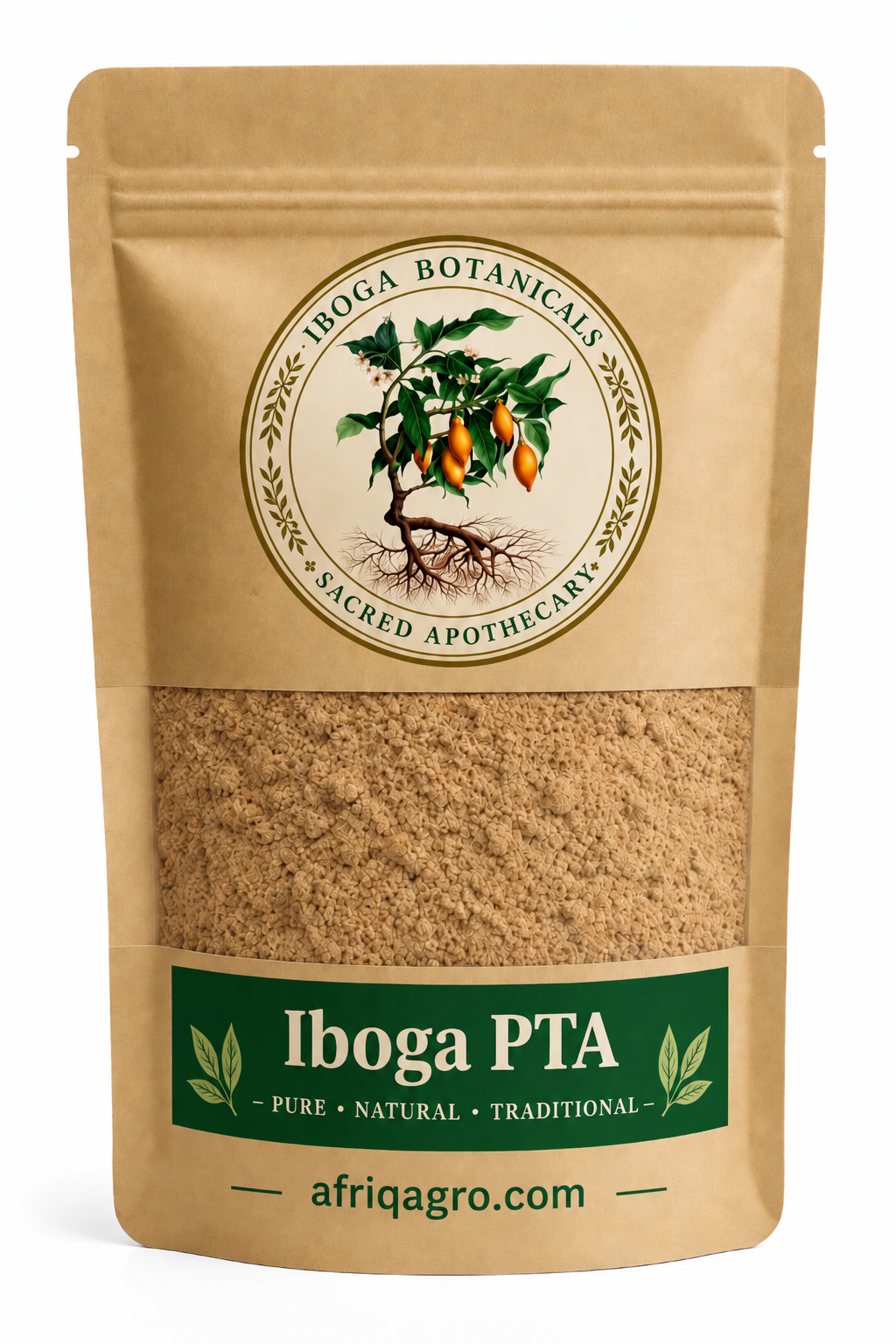
Iboga pta extract
Technical Specifications
-
Botanical Source: Tabernanthe iboga (Inner Root Bark)
-
Extract Type: Purified Total Alkaloid (PTA) Extract
-
Active Concentration: High-potency purified indole profile (~70–80%+ active alkaloids)
-
Appearance: Fine, light amber to off-white purified extract powder
-
Purity & Composition: Pure refined botanical extract; zero synthetic additives, fillers, heavy metals, or residual extraction solvents
-
Origin: Ethically sourced from Central Africa (Gabon/Cameroon region)
All deliveries are 100% guaranteed and shipped in discreet, secure packaging to protect your privacy.
Iboga PTA Extract – Purified Total Alkaloid Reference
Iboga PTA extract is a term commonly used for a purified total-alkaloid preparation associated with botanical material from Tabernanthe iboga.
Unlike a single chemically defined compound such as ibogaine hydrochloride, PTA generally refers to a mixture containing multiple alkaloids. Consequently, the exact chemical composition can vary between preparations and should not be assumed from the name alone.
Scientific analysis of Tabernanthe iboga root bark has identified numerous alkaloids rather than a single constituent. In one metabolomic study, researchers detected around 30 alkaloid signals, including previously recognized iboga-type compounds. PubMed Central (PMC)
Therefore, the strongest AfriqAgro page should focus on identity, botanical origin, batch composition and analytical documentation rather than presenting PTA as a fixed-purity substance.
Iboga PTA Extract Overview
The Iboga PTA extract listing should describe the material according to the actual analytical information available for the batch.
The initials PTA are generally used commercially to mean Purified Total Alkaloid. However, this term does not identify one specific molecule.
A current industry reference distinguishes PTA from both total alkaloid preparations and ibogaine hydrochloride, while also noting that PTA does not have a universally defined analytical threshold. iboga.co
As a result, useful product documentation should include:
- Botanical source
- Source country
- Batch or lot number
- Analytical method
- Total alkaloid result, when tested
- Individual alkaloid profile, when available
- Laboratory name
- Certificate of analysis
- Physical appearance
- Net weight
- Packaging information
- Storage instructions
Moreover, all percentages should correspond to the actual batch being described.
For related botanical and analytical reference materials, browse the AfriqAgro marketplace.
Botanical Source of Iboga PTA Extract
The botanical species associated with traditional iboga material is Tabernanthe iboga Baill.
Its classification includes:
- Kingdom: Plantae
- Order: Gentianales
- Family: Apocynaceae
- Genus: Tabernanthe
- Species: Tabernanthe iboga
Kew’s Plants of the World Online currently recognizes Tabernanthe iboga as an accepted species. Its native range extends from West-Central Tropical Africa to Angola, including Cameroon, Gabon, Congo, Democratic Republic of the Congo, Central African Republic and neighboring areas. Plants of the World Online
Additionally, Kew describes the species as a shrub or tree associated primarily with the wet tropical biome. Plants of the World Online
For authoritative botanical taxonomy, use:
Kew – Plants of the World Online: Tabernanthe iboga
What Does PTA Mean?
In commercial terminology, PTA usually means Purified Total Alkaloid.
However, the term should not be confused with a recognized single chemical substance.
A commonly used distinction is:
- Root bark: original botanical plant material
- TA: total-alkaloid preparation
- PTA: further purified alkaloid mixture
- Ibogaine HCl: chemically defined hydrochloride form of ibogaine
Importantly, the available scientific literature discusses Tabernanthe iboga alkaloids and chemically characterized extracts, but the commercial label PTA itself does not establish a fixed composition.
Therefore, avoid treating statements such as:
“PTA 90%”
or
“PTA contains exactly X% ibogaine”
as universal specifications.
Those figures should only appear when they come from the actual batch’s analytical report.
Alkaloid Profile of Tabernanthe Iboga
Tabernanthe iboga contains a chemically diverse family of monoterpene indole alkaloids.
Scientific literature identifies ibogaine as a major representative of the iboga alkaloid family. Other alkaloids have also been documented in the plant. PubMed
For example, metabolomic analysis of T. iboga root bark detected numerous known and tentatively identified alkaloids rather than a chemically uniform single constituent. PubMed Central (PMC)
Consequently, an Iboga PTA extract should be described as a multi-component preparation unless testing demonstrates otherwise.
Furthermore, the relative proportions of individual compounds can depend on botanical material, processing and purification.
PTA Is Different From Ibogaine HCl
Iboga PTA extract and ibogaine hydrochloride should not be presented as interchangeable products.
Ibogaine hydrochloride is a chemically defined salt recorded by PubChem with:
- Name: Ibogaine hydrochloride
- PubChem CID: 197059
- Formula: C20H27ClN2O
- Molecular weight: approximately 346.9 g/mol
- Referenced CAS: 5934-55-4 PubChem
PTA, by comparison, generally refers to a mixture of alkaloids rather than one chemically defined molecule.
Therefore, do not copy the molecular formula, CAS number or molecular weight of ibogaine hydrochloride into the PTA specifications.
That would incorrectly imply that the two materials are chemically identical.
Batch Composition and Analytical Testing
For an Iboga PTA extract reference page, batch-specific analysis is particularly important.
Useful testing information may include:
- HPLC or LC-MS profile
- GC-MS analysis where applicable
- Total alkaloid measurement
- Individual alkaloid identification
- Assay result
- Batch number
- Sample date
- Laboratory name
- Certificate number
- Testing limitations
For example, if your laboratory report identifies a particular percentage of ibogaine, enter the exact documented result for that batch.
However, avoid automatically describing every PTA batch as:
“90% pure”
“95% alkaloids”
“98% pure”
or any other fixed figure.
Moreover, phrases such as “pharmaceutical grade” and “certified purity” should only be used when the relevant certification actually exists.
Physical Description
The appearance of an alkaloid preparation can vary according to composition and processing.
Therefore, the actual batch should determine how the material is described.
Useful physical documentation may include:
- Powder or solid form
- Observed color
- Texture
- Net weight
- Packaging type
- Lot number
- Date packaged
Additionally, photographs should depict the actual product or a clearly identified representative sample.
Avoid claiming that color or appearance alone verifies purity, because visual appearance does not establish chemical composition.
Analytical Documentation
A strong reference listing should prioritize verifiable analytical information.
For that reason, consider recording:
- Batch number
- Date tested
- Testing laboratory
- Analytical technique
- Reported alkaloids
- Assay values
- Certificate of analysis
- Sample identifier
- Country of botanical origin
Furthermore, any laboratory report displayed on the page should correspond to the batch being listed.
This makes the page considerably more credible than simply writing “lab tested” without supporting information.
Botanical Origin
Tabernanthe iboga is naturally distributed across West-Central Tropical Africa into Angola. Plants of the World Online
However, the botanical native range should not be confused with the origin of an individual PTA preparation.
Therefore, your WooCommerce specification should use:
Botanical source country: Actual documented source
rather than automatically writing:
Cameroon
Gabon
or
Congo Basin
unless your sourcing documentation confirms that location.
This approach improves product transparency and reduces unsupported geographic claims.
Safety Information
Iboga preparations may contain ibogaine, a pharmacologically active psychoactive alkaloid.
Modern medical literature identifies clinically significant cardiovascular risks associated with ibogaine, particularly QTc prolongation and potentially dangerous ventricular arrhythmias. PubMed
Therefore, an AfriqAgro reference page should not describe PTA as:
“safe”
“non-toxic”
“risk free”
or appropriate for unsupervised administration.
Furthermore, the composition of mixed-alkaloid preparations can vary, which makes unsupported potency or safety comparisons inappropriate.
Regulatory Considerations
The legal status of iboga-derived alkaloid preparations differs by jurisdiction.
For example, ibogaine is a Schedule I controlled substance in the United States, and DEA’s current resource guide lists ibogaine under Schedule I with DEA number 7260. DEA
Consequently, I would not publish claims such as:
“legal worldwide”
“ships to every country”
or
“full international regulatory compliance”
as universal statements.
Instead, a neutral compliance statement can read:
Regulatory requirements for iboga-derived alkaloid preparations vary by jurisdiction. Applicable laws and import requirements should be verified for the relevant destination.
Packaging and Storage Documentation
An Iboga PTA extract listing should use packaging and storage information supported by the batch documentation or applicable safety data.
Useful label information includes:
- Material name
- Batch number
- Net quantity
- Source information
- Date packaged
- Relevant analytical information
- Storage conditions
If you have a laboratory or supplier specification, use its exact storage instructions.
Otherwise, avoid inventing precise stability periods or shelf-life claims.
Iboga PTA Extract Technical Summary
Overall, Iboga PTA extract is best understood as a commercial term for a purified mixture of alkaloids associated with iboga botanical material rather than a single standardized chemical substance.
Tabernanthe iboga itself contains multiple iboga-type alkaloids, and published phytochemical research demonstrates significant chemical complexity in the plant. PubMed Central (PMC)
Therefore, the most important characteristics of a PTA preparation are not the letters PTA alone, but rather:
- Botanical source
- Batch identity
- Analytical profile
- Individual alkaloid measurements
- Laboratory documentation
- Geographic source
- Physical condition
Furthermore, any purity or composition percentage should be treated as batch specific rather than universal.
Iboga PTA Extract Key Specifications
- Product/reference name: Iboga PTA extract
- Common expansion of PTA: Purified Total Alkaloid
- Material type: Multi-alkaloid preparation
- Botanical association: Tabernanthe iboga
- Plant family: Apocynaceae
- Genus: Tabernanthe
- Botanical species: Tabernanthe iboga Baill.
- Native range of species: West-Central Tropical Africa to Angola
- Primary botanical biome: Wet tropical
- Chemical character: Mixture rather than single defined compound
- Ibogaine content: Batch-specific; verify analytically
- Total alkaloid content: Batch-specific
- Physical form: State actual batch form
- Color: State actual observed color
- Batch identification: Strongly recommended
- Certificate of analysis: Recommended
- Analytical method: State actual method
- Country of botanical origin: State documented origin
- Storage: Follow batch documentation/SDS
- Regulatory status: Jurisdiction dependent
- Intended page positioning: Analytical/reference information
Related products
Iboga pta extract
300 CFA
Technical Specifications
-
Botanical Source: Tabernanthe iboga (Inner Root Bark)
-
Extract Type: Purified Total Alkaloid (PTA) Extract
-
Active Concentration: High-potency purified indole profile (~70–80%+ active alkaloids)
-
Appearance: Fine, light amber to off-white purified extract powder
-
Purity & Composition: Pure refined botanical extract; zero synthetic additives, fillers, heavy metals, or residual extraction solvents
-
Origin: Ethically sourced from Central Africa (Gabon/Cameroon region)
All deliveries are 100% guaranteed and shipped in discreet, secure packaging to protect your privacy.